
That blank line in your proposal, the one next to “Total Project Cost”, can feel like a high-wire act. On one side, you fear scaring off a perfect client with a number that’s too high. On the other hand, you dread the slow burnout of undervaluing your own time and skill. This is the universal dilemma of the freelancer. Consequently, mastering freelance pricing is not just about arithmetic; it’s about psychology, value perception, and business strategy. Therefore, this guide is designed to replace that anxiety with confidence. We will dissect the core pricing models, provide a clear framework for calculating your rates, and equip you with negotiation scripts. Ultimately, you will learn how to set freelance pricing that attracts great clients, reflects your true worth, and builds a sustainable, profitable business.
The Foundation: Shifting Your Mindset from Cost to Value
Before we crunch numbers, a fundamental mindset shift is essential. The most successful freelancers do not sell their time; they sell solutions and outcomes.
When you focus solely on hours, you inevitably hit an income ceiling. There are only so many billable hours in a week. Conversely, when you focus on the value you provide, your earning potential becomes limitless. For instance, a website you build isn’t just code and design; it’s a 24/7 sales engine, a credibility booster, and a lead generation machine for your client’s business. Consequently, your freelance website building pricing should reflect that transformative value, not just the days it took to code it. This value-first perspective is the cornerstone of profitable freelance pricing.
The Three Pillars of Your Pricing Strategy
Your price should never be a random guess. Instead, it must rest on three key pillars:
- Your Costs: This is your baseline. Calculate your business and living expenses. Include software, hardware, taxes, healthcare, and your desired personal salary. If your monthly payments are $5,000, your rates must cover that before you even think about profit.
- The Market Rate: Research what other freelancers with similar skills and experience are charging. Platforms like Upwork or Payscale can offer a range, but remember that these often skew low. Use them for context, not as your final number.
- Your Unique Value: This is your premium. What specific results do you deliver? Do you have a niche specialty? Have you won awards? Do you complete projects faster or with higher quality? This is what allows you to charge above the “average” market rate.
Demystifying the Core Pricing Models
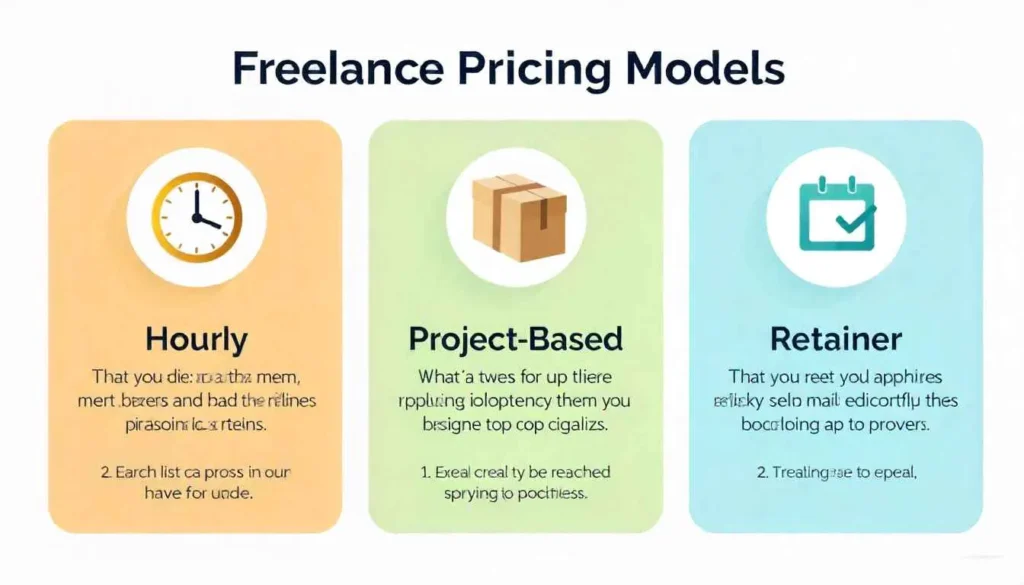
There is no single “best” way to price. The right model depends on the project, the client, and your own preferences. Here is a breakdown of the three most common structures in freelance pricing.
The Hourly Rate: Simple but Limiting
Charging by the hour is straightforward and feels safe, especially for beginners. It ensures you get paid for every single minute you work.
When to use it: Use hourly pricing for projects with unclear scopes, ongoing support, or where the client is likely to request many changes. For example, troubleshooting a technical issue or providing ongoing consulting is well-suited to an hourly model.
The major drawback: Your income is directly capped by your time. Furthermore, you are penalized for becoming more efficient. If you finish a task in two hours instead of three, you make less money. Therefore, this model can inadvertently discourage innovation and speed. For more about Freelance Pricing: How to Value Your Work & Win Clients, visit Freelance Family Man.
Project-Based Pricing: The Gold Standard for Value
This is where you quote a fixed price for the entire project deliverable. This method aligns perfectly with a value-based freelance pricing strategy.
When to use it: Project pricing is ideal for well-defined projects with a clear start and end point. This includes building a website, designing a logo, or writing a white paper. For freelance website building pricing, this is often the most professional approach.
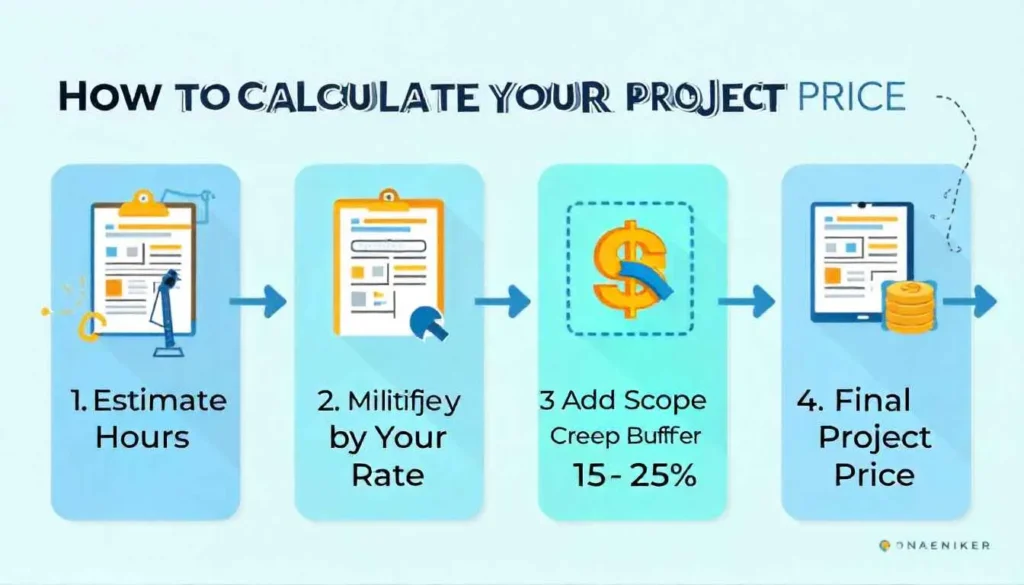
How to calculate it: First, do not guess. Estimate the total hours you think it will take. Then, multiply that by your desired hourly rate. Finally, add a buffer of 15-25% for scope creep, revisions, and unforeseen challenges. This final number is your project fee. You are now charging for the outcome, not the labor.
The Retainer Model: The Key to Predictable Income
A retainer is a recurring fee for a set package of services or a block of your time each month. This is the holy grail for stable freelance pricing.
When to use it: Retainers are perfect for long-term clients who need ongoing work, such as social media management, monthly website maintenance, or a consistent stream of blog content.
The immense benefit: Retainers provide predictable, recurring revenue. This stability allows you to plan your finances, reduce the constant stress of finding new clients, and focus on delivering deep, consistent value. For more on building a resilient business structure, explore our guide on gillibilli.shop.
A Practical Case Study: Freelance Website Building Pricing
Let’s apply these models to a concrete example. Imagine a client needs a new 5-page small business website.
The Hourly Approach:
You estimate 40 hours at $75/hour. Your quote is $3,000. If you finish in 35 hours, you earn $2,625. If it takes 45 hours, you earn $3,375. The client bears the risk of the project timeline.
The Project-Based Approach:
You analyze the value. This website will help the client establish an online presence, generate leads, and look professional. You calculate your costs and value, and propose a fixed fee of $4,500. Whether it takes you 30 or 50 hours, you get paid $4,500. You now have an incentive to work efficiently, and the client has budget certainty
The Retainer Approach (Post-Launch):
After building the site for $4,500, you offer a “Care Plan” retainer for $500/month. This includes hosting, security updates, and 2 hours of content changes. This creates lasting income from a single project.
Clearly, the project-based and retainer models often lead to better outcomes for both you and the client.
The Art of the Confident Negotiation
Presenting your price is just the beginning. How you handle the subsequent conversation is critical.
Scripts for Common Client Objections
1. Objection: “That’s more than we budgeted.”
- Your Response: “I understand staying within budget is important. Can you help me understand what you had allocated? Perhaps we can adjust the project scope to align with that number while still achieving your core goals. Alternatively, we could phase the project, starting with the most critical elements first.”
2. Objection: “We have another freelancer who quoted less.”
- Your Response: “That’s a valid consideration. My pricing reflects my specific expertise in [mention your niche, e.g., e-commerce websites], which includes [mention a key benefit, e.g., optimized speed and SEO structure]. This ensures you get a higher return on investment through [mention a result, e.g., better conversion rates]. I’m confident the value I deliver justifies the investment.”
3. Objection: “What’s your hourly rate?” (When you’ve quoted a project fee)
- Your Response: “I price based on the value and deliverables of the project, not just the time. This ensures we’re both focused on the result, a high-quality website that meets your business objectives, rather than the clock. This approach actually saves you money if the project takes me longer than anticipated.”
Presenting Your Price with Unshakable Confidence
The way you communicate your price in a proposal is as important as the number itself.
- Always Lead with Value: Before the client ever sees the price, recap the project goals, the problems you’ll solve, and the benefits they’ll receive.
- Use “Therefore” Logic: Structure your proposal as: “You have [this problem] and want [this outcome]. Therefore, I will provide [this solution], which includes [these specific deliverables]. The investment for this is [$X].”
- Offer Clear Packages: Presenting multiple options (e.g., Basic, Pro, Enterprise) can make the decision easier and often guides clients to a middle or higher-priced package.
Conclusion: Your Price is a Statement of Your Worth
In conclusion, effective freelance pricing is a dynamic skill that blends calculation with communication. It requires the courage to charge for the transformation you create, not just the tasks you complete. By adopting a value-based mindset, choosing the right pricing model for each situation, and negotiating with prepared confidence, you fundamentally change your business trajectory. You will stop competing on price and start attracting clients who recognize and are willing to pay for excellence. Therefore, step onto that high wire with confidence. That blank line in your proposal is not a void of uncertainty; it is a space for you to confidently state your worth.
All images are generated by Freepik.
Frequently Asked Questions:
Start by calculating your annual living and business expenses. Add your desired annual salary. Then, divide that total by the number of billable hours you expect to work in a year (e.g., 20 hours/week x 46 weeks = 920 hours). This gives you your minimum viable hourly rate. Always price above this to account for profit and taxes.
It’s generally better not to display a specific hourly rate publicly. Instead, describe your project starting prices or package rates. This prevents anchoring clients to a low hourly number when your project-based pricing delivers far greater value.
First, don’t immediately discount. Instead, reiterate the value and ROI you provide. Ask questions to understand their budget constraints. Then, see if you can adjust the project scope to fit their budget or propose a phased approach. If they still can’t afford you, it’s okay to walk away politely.
A good rule of thumb is to review and slightly increase your rates annually, especially for new clients. You should also consider a raise when you gain a significant new skill, achieve a major result for a client, or if your demand consistently exceeds your availability.
Charging per project is almost always superior. A “per page” model can become contentious if the client’s definition of a “page” changes. Project pricing allows you to focus on the overall functionality and value of the website, and it protects you from endless minor additions that the client may not see as a new “page.”