
There is always one moment that exposes the truth about a design system. It usually happens late, during a rushed release, when someone asks a simple question: “Which button should we use here?” If the answer takes more than a few seconds, the system is not doing its job.
In growing organizations, this moment repeats itself often. Products multiply, teams split, and decisions that once lived in people’s heads turn into documents, tickets, and debates. Consistency starts slipping, not because anyone stopped caring, but because shared memory no longer scales.
Design systems emerge from this pressure. Not as a creative ambition, but as a survival mechanism. They exist to reduce friction, not to impress. And in the real world, they rarely look as clean as conference talks suggest.
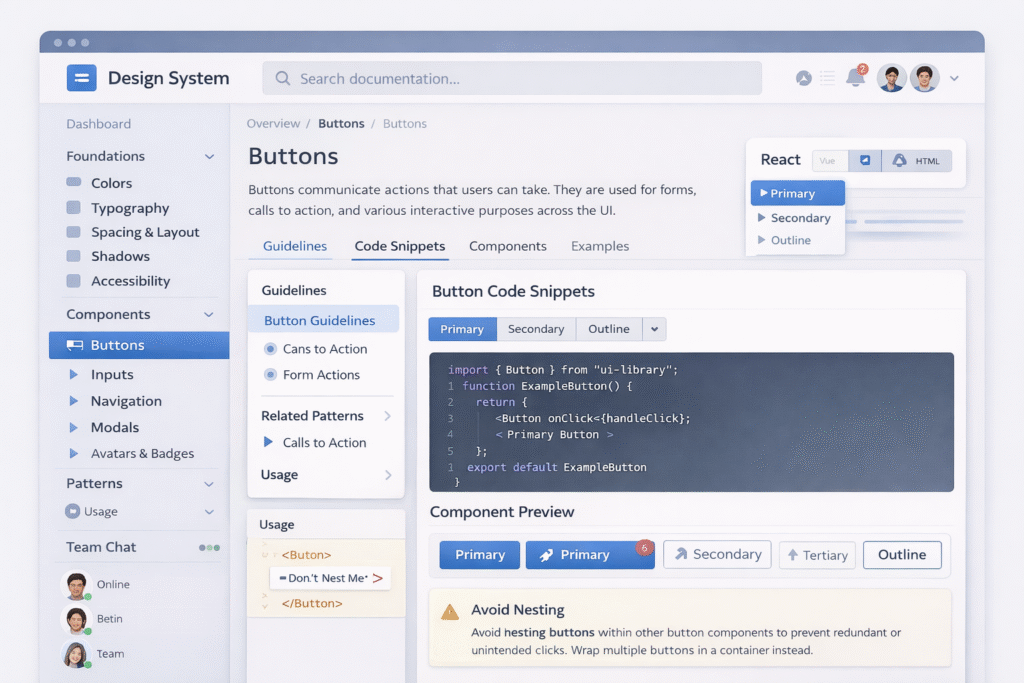
Why Design Systems Become Necessary
When teams are small, alignment happens naturally. Designers sit close to engineers. Feedback loops are short. Decisions travel by conversation. As soon as an organization grows beyond a handful of teams, that informal structure breaks.
Different squads solve the same problems in slightly different ways. At first, the differences feel harmless. Over time, they pile up. Users start to notice. Internal reviews get longer. Small interface decisions consume disproportionate energy.
At that point, a design system stops being optional. It becomes a way to stabilize decision-making. Instead of debating the basics repeatedly, teams agree on defaults and move on. The system does not replace thinking. It removes unnecessary repetition.
What a Design System Really Is
In practice, a design system is less a library and more an agreement. It defines what teams can rely on without discussion.
There are visible pieces, like shared interface elements and visual rules. There are also invisible ones, like naming habits, assumptions about behavior, and unspoken limits around variation. The strongest systems acknowledge both.
Problems begin when systems pretend to be static. Products change. Constraints shift. Teams discover new edge cases. Systems that survive treat change as expected, not as failure.
Where Theory Collides With Reality
Every organization faces the same tensions once a system starts spreading. Speed conflicts with oversight. Teams want autonomy, while leadership wants coherence. Legacy products resist alignment.
In theory, governance solves this. In reality, heavy review slows teams down and creates quiet resistance. The most effective approach usually sits in the middle. Defaults are clear. Exceptions are allowed. Deviations are visible rather than hidden.
Legacy work is handled gradually. New features follow the system. Old areas are updated only when touched for other reasons. This pace frustrates purists, but it keeps momentum alive.
Ownership also becomes complicated. Designers define intent. Engineers define behavior. When either side moves alone, gaps appear. Systems mature only when both groups share responsibility instead of handing work back and forth.
Read about 21 ways to improve team productivity here.
A Familiar Story From the Field
A mid-sized software company once ran three products that looked similar but never quite matched. Buttons aligned differently. Spacing changed from screen to screen. None of it was dramatic, yet users sensed inconsistency.
Internally, the cost was obvious. Teams rebuilt the same patterns repeatedly. Designers spent time policing details instead of improving flows. Engineers worked around inconsistencies rather than fixing them.
The company introduced a shared system slowly. It did not replace everything. Teams used it for new work first. Older screens stayed as they were until meaningful updates justified refactoring.
Progress was uneven. Some teams adopted quickly. Others resisted quietly. Over time, the system proved its value. Conversations shortened. Reviews focused on substance. The visual noise faded.
How Impact Shows Up Over Time
Very few teams can point to a single metric that proves a system worked. The benefits surface gradually.
Design reviews become calmer. Engineers stop questioning basic patterns. New team members onboard faster because decisions feel predictable. Maintenance becomes easier because changes happen once instead of everywhere.
Perhaps most importantly, trust increases. Teams trust the system enough to stop reinventing fundamentals.
Documentation That People Actually Use
Documentation often determines whether a system survives or not. When it reads like a rulebook, it gets ignored. When it explains reasoning, it gets referenced.
Useful documentation answers everyday questions. It reveals how things work, not just how they appear. Clear boundaries around flexibility become visible. And it shows how to suggest improvements without triggering a political fight.
When documentation stays current, the system stops living only in a few people’s heads.
You are curious how massive should be your team. Learn More
Governance Without Drama
Governance works best when it feels boring. Clear paths exist for proposing changes. Small groups handle meaningful decisions. Automated checks catch obvious issues early.
When rules are predictable, teams stop pushing against them. Creativity survives because energy is spent on real problems, not on negotiating basics.

Adoption Is About People
No system succeeds because it was announced in a meeting. Teams adopt what they understand and trust.
Training helps, but examples help more. When teams see work move faster and reviews get easier, adoption follows. Feedback loops matter. When suggestions disappear into silence, engagement fades.
Over time, the system stops feeling external. It becomes shared ground.
Common Failure Modes
Many systems fail quietly. Components grow bloated. Variations multiply without purpose. Accessibility gets postponed. Ownership becomes unclear.
These issues rarely appear suddenly. They creep in when attention shifts elsewhere.
Teams that acknowledge this treat maintenance as ongoing work, not as a one-time launch.
More Than Components
Design systems in the wild shape how organizations think. They influence priorities, collaboration, and how decisions get made under pressure.
At their best, they reduce noise and create space for meaningful design work. At their worst, they become obstacles.
The difference lies in how honestly teams treat them.
Conclusion
Design systems are rarely elegant behind the scenes. They evolve through compromise, missed expectations, and gradual alignment. Yet when handled with care, they allow large teams to move together without moving slowly.
They are not about control. They are about trust. And when that trust holds, creativity does not disappear. It finally has room to breathe.
FAQs About Design Systems in the Wild
What is a design system in practice?
A design system is a collection of reusable components, tokens, and guidelines that standardize UI and UX across products.
Why do large companies need design systems?
They ensure consistency, reduce duplication, and improve collaboration across multiple teams and products.
How do organizations measure the success of a design system?
Metrics include time saved on development, visual consistency audits, reduced technical debt, and cross-team efficiency.
What are common challenges in implementing design systems?
Challenges include team resistance, legacy code, governance friction, and accessibility enforcement.
How can teams encourage adoption of a design system?
Through evangelism, training, clear documentation, feedback loops, and demonstrating tangible efficiency gains.