
Every click, subscription, and interaction on the Web creates data. To marketers, this online presence provides a level of insight into the actions of the users never seen before, making it possible to create hyper-personalized campaigns. However, it comes with a lot of responsibility that comes with data.
Privacy and ethics in marketing are no longer fringes of data protection, but rather how a brand can gain trust, stay within the compliance limits, and stay long-term interesting. User rights are codified in legislation such as GDPR in Europe and CCPA in California that influence what marketers can collect, store, and use. At the same time, the demands of the users regarding transparency, consent, and ethical use of data are increasing worldwide.
By disregarding these facts, one may not just face regulatory fines but also face a negative reputation, decreased participation, and a drop in campaigning. This paper focuses on the impact of emerging changes in data privacy regulations, ethical standards, and consumer demands on the marketing strategy. We discuss real-world examples, applications, and tips to be responsible senior digital marketers and strategists to navigate this complex environment.
The Current Legal Landscape: GDPR, CCPA, and Beyond
Digital marketing is increasingly regulated:
- General Data Protection Regulation ( GDPR): imposes express consent, data minimization, and user rights in the EU. Breachs are fined up to 20million or 4 percent of worldwide income. l
- CCPA (California Consumer Privacy Act): The law will provide California residents with the right to access, delete, and opt out of the sale of personal data. Violation fines are up to 7,500.
- New International Laws: Brazil’s LGPD and India’s PDP Bill (as well as similar laws in other countries around the world) are indicative of the tendency towards effective privacy protections.
Marketers need to create legally compliant campaigns, rather than making them compliant. This involves interpretation of the letter of the law as well as the spirit, user autonomy, and transparency.
Ethical Dimensions in Marketing
Ethical marketing does not just entail legal compliance. Ethics deal with the manner in which information is gathered, processed, and used in a manner that upholds personal rights:
- Transparency: The users must know about what data is being collected, why, and how it is being used.
- Consent: In addition to legal consent, it must be informed, specific, and revocable.
- Fairness: Do not personalize manipulatively, predatoryly, or obscurely.
- Purpose Limitation: Data may only be utilized in mentioned reasons; any subsequent usage must be reported.
Ethical marketing enhances brand trust, firms in competitive markets, and lowers the risk in the long run.
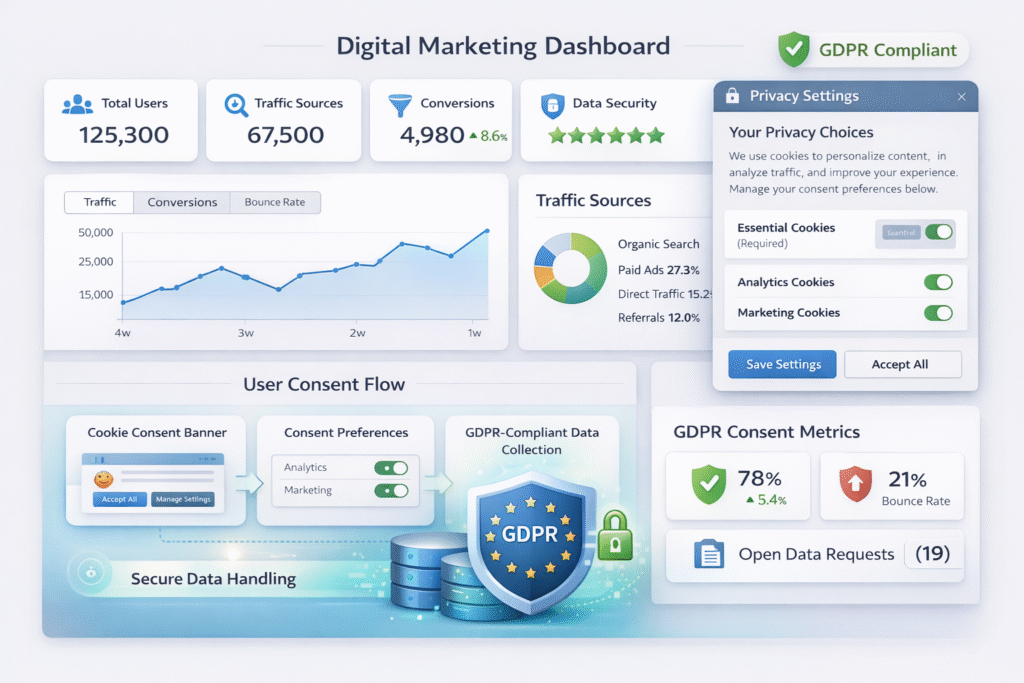
Consumer Expectations in a Privacy-Conscious Era
According to surveys, users are getting more demanding of brands to treat their data with respect:
- Three-quarters of consumers indicate that they worry about the way firms utilize their information.
- Half of them (57 percent) would cease to buy a product of a company that abuses personal data.
- One out of every six is ready to share data in case the value is visible, transparent, and safe.
This change focuses on the fact that privacy is not a barrier; it is a strategic distinction. Trust, loyalty, and increased engagement can be developed through campaigns that meet the expectations of the user.
Marketing Strategies Adapted for Privacy and Ethics
1. Consent-First Campaigns
Prioritize clear, granular consent over blanket permissions:
Explicit opt-ins for newsletters, personalized offers, and behavioral tracking
Layered consent experiences allow users to select preferences without friction
Case Study: A European online retailer restructured its sign-up process to align with GDPR, providing segmented consent. Findings: The rate of opening the emails grew by 15 percent, which is an indication that transparency improves the interaction.
2. Data Minimization and Security
Gather no more than is necessary, keep it safe, and have retention policies:
- Do not over-gather behavioral information or demographic information.
- Use encryption, access control, and frequent audits.
- Advise security protocols to end users to build confidence.
Example: A fintech platform applied anonymization and encryption of data on the transaction. The openness of these measures increased user trust, and churn was minimized.
3. Contextual Personalization
Ethical personalization balances relevance with privacy:
Use first-party data responsibly to deliver contextual offers
Avoid intrusive cross-platform tracking without consent
Provide clear opt-out options for targeted campaigns
According to behavioral research, users are open to personalization when it is meaningful, transparent, and secure, which forms an engagement without going against expectations.
4. Privacy-First Measurement
Traditional analytics often rely on third-party cookies, which are increasingly restricted:
Leverage server-side tracking, first-party cookies, or privacy-compliant attribution methods
Shift to cohort-based metrics and aggregated insights to understand campaign performance without identifying individuals
Be open with users about the use of data to make decisions.
Case: One of the world-renowned retailers implemented a privacy-friendly measurement system that ensures proper campaign tracking but does not disrespect user permissions.
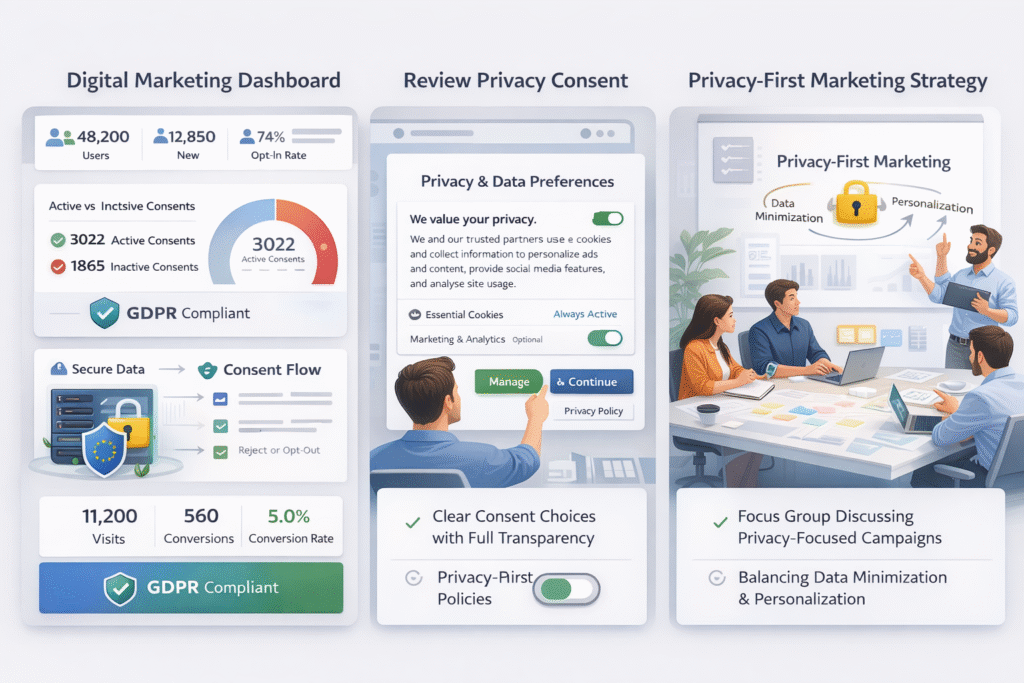
Real-World Case Study: Navigating GDPR in Marketing
A SaaS company targeting EU clients faced potential GDPR penalties for marketing automation workflows that relied on third-party email data. Their solution:
Audited all data sources and eliminated non-compliant contacts
Introduced double opt-in and preference centers
Replaced non-essential third-party integrations with in-house solutions
Outcome:
Legal compliance achieved with zero penalties
Customer trust scores improved by 20%
Email open rates increased due to targeted, consented communications
This case illustrates that privacy-aligned campaigns can be both compliant and effective.
The Business Case for Ethical Data Use
Ethical marketing and privacy compliance are strategic levers:
Trust: Increases repeat engagement and reduces churn
Differentiation: Brands perceived as privacy-conscious gain a competitive advantage
Long-Term ROI: Responsible data practices reduce legal risk and support sustainable growth
Customer Lifetime Value: Transparent interactions encourage repeated conversions and advocacy
Compliance and ethics are not constraints; they are catalysts for high-performing, sustainable marketing.
Challenges and Pitfalls
Despite benefits, practical challenges remain:
Balancing Personalization and Privacy: Hyper-targeting can conflict with data minimization principles
Global Compliance Complexity: Multijurisdictional campaigns require tailored consent and storage strategies
Measurement Trade-Offs: Privacy-centric tracking may reduce the granularity of insights
Consumer Skepticism: Users may distrust even compliant data practices if communication is unclear
Strategic planning and proactive communication mitigate these challenges, turning compliance into an asset rather than a limitation.
Future Trends: Privacy as Competitive Advantage
Emerging trends indicate privacy-conscious marketing will become standard:
Zero-Party Data Growth: Voluntarily provided user data allows precise targeting without invasive tracking
AI-Driven Privacy Solutions: Algorithms enable personalization while respecting anonymization and consent
Regulation-First Strategy: Companies adopting privacy-by-design gain early compliance and brand credibility
Ethical Branding: Transparency, purpose limitation, and ethical use increasingly influence consumer choice
Brands that integrate privacy into their strategy position themselves for trust, engagement, and sustainable digital campaigns.
Conclusion: Ethics and Privacy Are Strategic Imperatives
The principles of marketing and privacy of data are transforming the principles of digital interaction. The current global expectations, along with GDPR and CCPA, demand compliance with the law, but not only that, they demand ethical strategy, transparency, and respect towards the rights of users.
Privacy-oriented campaigns are more reliable, more captivating, and eventually more successful. To marketers and senior strategists, the way to go is to accept privacy-first models, incorporate ethical values into personalization, and communicate freely with users. Information is great; however, loyalty is precious.
Legal requirements to conduct ethical and privacy-compliant campaigns are not only a long-term strategic profit, but also an unpaid position in a digital ecosystem where attention, loyalty, and engagement are not granted but acquired.
FAQs About Data Privacy and Marketing Ethics
What is the relationship between data privacy and marketing ethics?
Marketing ethics ensures data is collected, processed, and used responsibly, beyond mere legal compliance, to maintain user trust and transparency.
How do GDPR and CCPA impact digital campaigns?
They establish user rights to consent, access, and deletion, requiring marketers to adjust data collection, personalization, and measurement strategies.
Can privacy-compliant campaigns still be effective?
Yes. Transparency, consent-driven personalization, and ethical targeting often increase engagement and trust.
What are the risks of ignoring data privacy?
Non-compliance can lead to fines, legal penalties, reputational damage, and loss of user trust.
How can brands build trust while using customer data?
By clearly communicating data usage, limiting collection to necessary information, and offering granular control and opt-out options.