
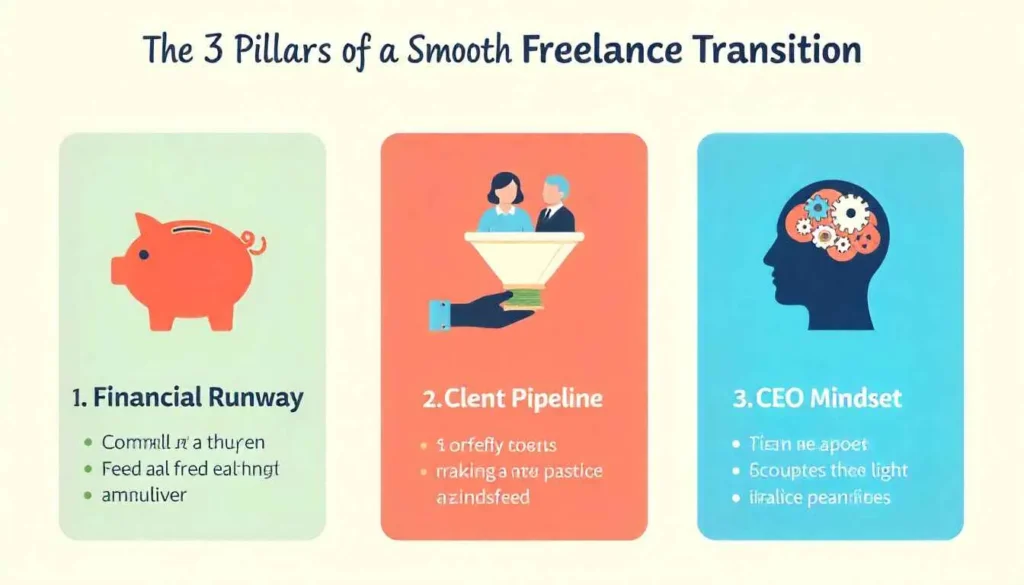
When that alarm clock goes off, and for the first time in… well, probably many years, you don’t hit snooze with dread? Rather, you feel energized. Today, you are working for yourself. This reign of your independence is the dream that inspires you to transition to freelancing. But it is important to understand that the journey from a steady paycheck to a self-sustaining, profitable business is not often one big, daring jump. It is a bridge built by planners, patience, and pragmatism. Therefore, you are reading this guide to be your own bridge blueprint. We’ll take you through the three components of a smooth transition: building a financial runway, building your client pipeline, and, of course, that all-important mindset reset. So, if you are ready to swap your commute for control, let’s figure out how to walk through this incredible journey without the panic.
The foundation of your freelance transition: Your financial runway.
The number one pathway to an entrepreneurial transition failure is financial pressure. Without some degree of safety net, the first slow month may accelerate your need to be back in the job market. Therefore, your first (and, perhaps, most important) step is to build a runway.
Calculate Your “Freedom Number”
Your financial runway is the amount of money you have saved to cover your living expenses while you build your business. A common recommendation is 6-12 months of essential expenses.
How to calculate it:
- List all your monthly essential expenses (rent/mortgage, utilities, groceries, insurance, debt payments).
- Multiply this number by 6 (for a 6-month runway) or 12 (for a 12-month runway).
- This total is your “Freedom Number”, the savings goal you need to hit before handing in your notice.
This fund is not for new business equipment or luxuries; it’s a survival fund that provides the peace of mind to make informed decisions, not desperate ones.
Reduce Expenses and Manage Debt
While you’re building your runway, aggressively cut non-essential spending. Furthermore, create a bare-bones budget that you can realistically live on. This lower overhead will significantly reduce the monthly income you need to generate, making your freelance transition less stressful and more sustainable from day one. For more about how to transition from a Full-Time Job to a Full-Time Freelancer Smoothly, explore Kat Boogaard.,
The Engine: Building Your Client Pipeline Before You Leap
A smooth freelance transition means you have clients waiting, not that you start looking for them after you quit. Your goal is to build momentum while you still have the security of your job.
Start with a Side Hustle
Your full-time job is the perfect funding source for your freelance business. Use your evenings and weekends to take on small, manageable projects.
- This achieves three things:
- It generates initial income and testimonials.
- It helps you build a portfolio.
- It validates your service offering and pricing in the real world.
Platforms like Upwork, Toptal, or even leveraging your LinkedIn network are perfect for finding these initial projects.
Define Your Niche and Services
You cannot be a generic “freelancer.” You must have a clear answer to the question: “What do you do, and for whom?”
- Your Niche: Instead of “I’m a writer,” say “I’m a B2B tech writer who specializes in creating SaaS case studies.”
- Your Service Packages: Create 2-3 clear service packages (e.g., “Starter Website Package,” “Content Strategy & 4 Blog Posts”). This makes it easier for potential clients to understand and buy from you.
A defined niche makes marketing easier and allows you to command higher rates because you are an expert, not a generalist.
Create a Lead Generation System
Waiting for work to find you is a recipe for failure. You need active and passive systems to attract clients.
- Leverage Your Network: Inform trusted former colleagues, friends, and family about your new services. A simple, professional email announcement can be incredibly effective.
- Optimize Your LinkedIn: Your LinkedIn profile is your new business front door. Ensure it clearly states your services, showcases your portfolio, and uses keywords that your ideal clients would search for.
- Start Building an Online Presence: Create a simple portfolio website and consider starting a blog or newsletter that demonstrates your expertise. For more on this crucial step, explore our guide on gillibilli.shop.
Aim to have at least 2-3 committed clients or projects lined up before you give your notice.
The Mindset: The Inner Shift from Employee to CEO
This is the most underestimated part of the freelance transition. You are no longer an employee; you are the CEO, sales team, marketing department, and janitor of your own company.
Embrace the “CEO Mindset”
An employee thinks about tasks. A CEO thinks about strategy, growth, and systems. Start asking yourself:
- “What is the most valuable use of my time right now?”
- “How can I systemize this repetitive task?”
- “Is this client/project aligned with my long-term business goals?”
This shift is crucial for moving beyond just being “busy” to being truly productive and strategic.
Develop Discipline and Structure
Without a manager or set office hours, it’s easy to slip into procrastination or, conversely, burnout from overwork.
- Set Office Hours: Define when you work and when you are off. Protect your personal time fiercely.
- Create a Dedicated Workspace: This psychologically separates your work life from your home life.
- Dress for Work: You don’t need a suit, but changing out of your pajamas can signal to your brain that it’s time to focus. For more on this crucial step, explore our guide on gillibilli.shop.
Executing the Transition: Your Final Checklist
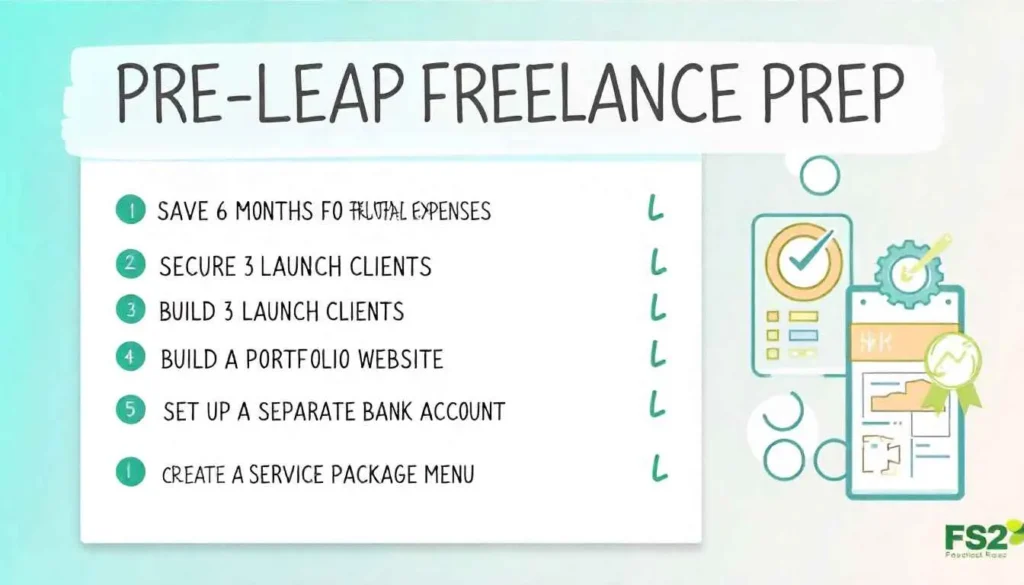
When your financial runway is built and your client pipeline is flowing, it’s time to make the move.
- Give Professional Notice: Resign from your job gracefully and professionally. Leave on the best terms possible; your former employer could become a future client or a valuable reference.
- Handle the Logistics: Notify your bank, set up a separate business account, and research health insurance options. Consider speaking to an accountant about taxes.
- Launch Officially: Once you’re free, make a formal announcement on LinkedIn and to your network. The momentum from your side hustle will now carry you into your full-time venture.
Conclusion: Building Your Bridge to Freedom
To sum up, transitioning to freelancing is not a spontaneous process but one that is built purposely; the runway, the client pipeline, and the CEO mindset comprise the pillars of the freelance project. Planning methodically on these three pillars should precede leaving your job, allowing you to substitute fear with confidence and ambiguity with a clear plan of action. So begin today! Open the aforementioned checking account, update your LinkedIn profile, and initiate your first small project. Your transformation from employee to empowered freelancer is ultimately a series of small and smart steps, not one giant and horrifying leap. It is worth planning for your future freedom.
All images are generated by Freepik.
Frequently Asked Questions (FAQs)
While 6-12 months of essential living expenses is the gold standard, the exact amount depends on your risk tolerance and industry. The key is to have enough saved to avoid making desperate decisions out of financial fear during the initial, potentially slow, months.
Absolutely. However, the transition may take longer. You’ll need to invest significant time in building new skills, creating a portfolio of sample work, and potentially taking lower-paying projects initially to gain experience and testimonials in your new niche.
Start with your existing network, including former colleagues, managers, and friends. Simultaneously, create profiles on relevant freelance platforms and begin sharing your knowledge on professional social media like LinkedIn. Your first clients often come from those you already know.
The biggest mistake is quitting their job without any clients or a financial safety net. This creates immense pressure that can lead to burnout and accepting low-quality, poorly paid work just to make ends meet, ultimately causing people to give up.
This varies widely. A well-planned transition with a built-up client pipeline can replace an income within a few months. For others, especially in competitive fields or without a clear niche, it can take 6-12 months or more to consistently match their previous salary.