
Imagine a tool built for one purpose: to make your business run better. It fits your workflow perfectly, solves your unique problems, and grows right alongside you. This isn’t a fantasy. This is the power of custom web application development. In a world of generic, one-size-fits-all software, a bespoke web app is your secret weapon. It’s the difference between wearing a borrowed suit and one tailored specifically for you. One is merely functional; the other empowers you to perform at your absolute best. So, if you’re tired of forcing your business to fit into off-the-shelf software, it’s time we talk about building something that actually fits.
What Exactly is a Custom Web Application?
Let’s start with the basics. A custom web application is a software program you access through a web browser, just like Gmail or Trello. However, unlike those mass-market products, a custom app is designed and built from the ground up for a specific set of users,usually, your team and your customers.
Think of it this way:
- Off-the-Shelf Software: Like buying a pre-made suit. It comes in standard sizes. It might be a bit loose here or tight there, but it’s ready to wear.
- Custom Web Application: Like visiting a master tailor. They take your precise measurements, discuss your style, and select the perfect fabric to create a suit that fits only you.
These applications live on a server and are delivered over the internet. This means your team can access them from anywhere, on any device, without complex installations. They can do anything from managing complex internal projects to providing a unique service directly to your clients.
The Unbeatable Advantages of Going Custom
Why would a business choose the custom path? The benefits are profound and directly impact your bottom line.
1. Perfect Process Fit
A custom application molds to your business, not the other way around. You automate the exact steps your team takes every day. For instance, a marketing agency might build an app that combines project management, client approval workflows, and billing into one seamless system. This eliminates the frustration of juggling multiple, disconnected programs.
2. Total Control and Ownership
When you build a custom web application, you own it. This means you control every feature, every update, and all your data. You are no longer at the mercy of a software company that might suddenly change its pricing, discontinue a feature you rely on, or get acquired. Your digital asset becomes a core part of your business’s value.
3. Enhanced Security and Compliance
Generic software is a big target for hackers. Because everyone uses the same system, a single vulnerability can affect thousands of companies. A custom application, however, is a much smaller and more unique target. Furthermore, you can build it to comply with specific industry regulations like HIPAA or GDPR from day one, which is a significant advantage for healthcare or finance businesses. You can learn more about building secure digital foundations in our guide to gillibilli.shop .
4. Scalability for Long-Term Growth
Your custom app is built with your future in mind. As your business grows and your needs evolve, your application can grow with you. Adding new users, features, or integrating with other systems is a planned process, not a painful migration. A 2023 report by Forrester highlighted that companies using tailored software solutions saw a 35% higher operational scalability compared to those relying on a standardized platform.
5. A Powerful Competitive Edge
This might be the most important point. A custom application can deliver a unique service or create an internal efficiency that your competitors cannot replicate. While they are all using the same tools, you are building a proprietary system that becomes a key differentiator in your market.
The Custom Development Lifecycle: A Clear, Step-by-Step Guide
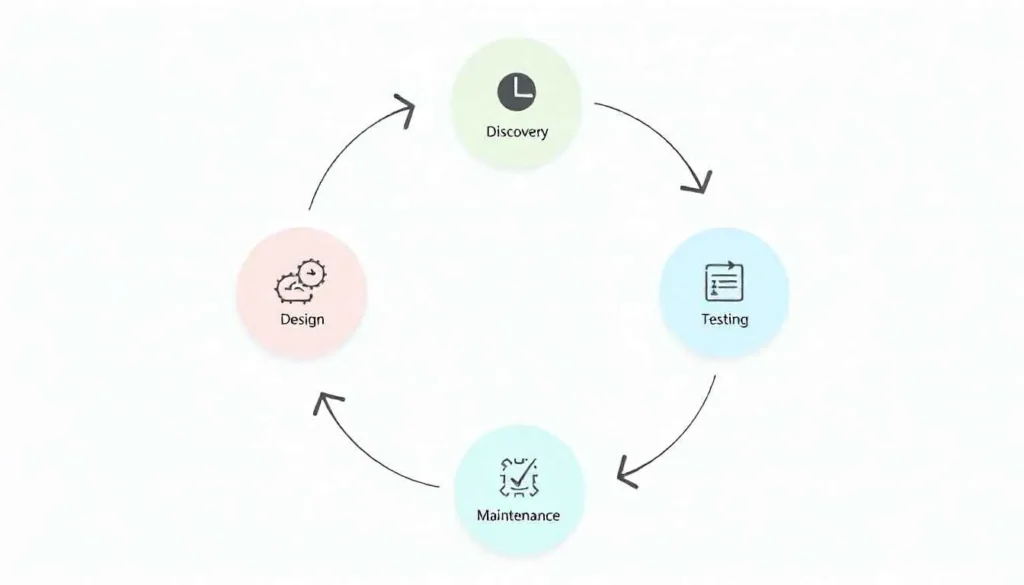
The process of building a custom web app is a partnership. It’s a structured journey from idea to launch. Here’s a breakdown of what you can expect.
Phase 1: Discovery and Strategy
This is the most critical phase. We sit down with you to understand your business goals, identify pain points, and define the exact problems the app will solve. We map out user roles, workflows, and desired outcomes. The result is a detailed project roadmap and a clear scope of work.
Phase 2: UX/UI Design
Now, we design the experience. User Experience (UX) design focuses on the app’s flow—how users will navigate and accomplish tasks. User Interface (UI) design focuses on the look and feel—the colors, typography, and visual elements. We create wireframes and prototypes for your feedback long before a single line of code is written.
Phase 3: Development and Integration
This is where the blueprint becomes a building. Developers write the code for the front-end (what the user sees) and the back-end (the server, database, and application logic). They also integrate the app with your existing systems, like your CRM or payment gateways, ensuring a unified ecosystem.
Phase 4: Rigorous Testing and Quality Assurance
Before launch, the application undergoes thorough testing. This includes checking for bugs, ensuring it works across different browsers and devices, and validating that all features function as designed. We also conduct performance and security testing to guarantee stability.
Phase 5: Deployment and Launch
Once testing is complete, we deploy the application to a live server. This involves configuring the hosting environment, migrating data, and officially launching the app for your users. It’s a coordinated effort to ensure a smooth go-live.
Phase 6: Ongoing Maintenance and Support
The relationship doesn’t end at launch. Technology evolves, and so do business needs. We provide ongoing maintenance, including security updates, performance monitoring, and feature enhancements to keep your application healthy and valuable for years to come.
Key Technologies in Modern Web App Development
The technology stack is the foundation of your application. The right choices ensure speed, security, and scalability.
- Front-End Frameworks: Technologies like React, Vue.js, or Angular are used to build fast, dynamic, and responsive user interfaces. They create the interactive parts of the app that users click and touch.
- Back-End Frameworks: Tools like Node.js, Django (Python), or Laravel (PHP) handle the business logic, server configuration, and database interactions on the server-side. They are the engine under the hood.
- Databases: Systems like PostgreSQL or MongoDB securely store and organize all your application’s data, from user profiles to transaction records.
The best stack depends entirely on your project’s specific requirements. A good development partner will recommend the most efficient and sustainable technology for your goals.
Is a Custom Web Application Right for Your Business?

How do you know if it’s time to invest in a custom solution? Ask yourself these questions:
- Are we constantly working around the limitations of our current software?
- Are we using five different programs to complete one business process?
- Is a lack of specific features holding back our growth or innovation?
- Are we spending more on monthly SaaS subscriptions than we would on an owned asset?
- Do we have a unique process that could be a market advantage if automated?
If you answered “yes” to any of these, a custom web application is likely a smart, strategic investment for your future.
Conclusion: Building Your Digital Cornerstone
Custom web application development is not just an IT project. It’s a business strategy. It’s a commitment to efficiency, a declaration of independence from generic tools, and an investment in a system that works as hard as you do. While the journey requires thoughtful planning and partnership, the destination is a powerful, proprietary tool that streamlines your operations, delights your customers, and solidifies your competitive advantage. In the digital age, the businesses that thrive are those bold enough to build their own future.
All images are generated by Freepik.
Frequently Asked Questions (FAQs)
Costs vary widely based on complexity, features, and the development team. A simple internal tool might start in the $20,000-$50,000 range, while a complex, multi-feature public application can be $100,000+. The best approach is to define your requirements and get a detailed quote.
The timeline is directly tied to the project’s scope. A basic minimum viable product (MVP) could take 2-4 months. A full-featured, enterprise-level application often requires 6-12 months or more of development, testing, and iteration.
A website is primarily informational (like a brochure). A web application is interactive and task-oriented. Users consume content on a website, but they do things (like manage projects, analyze data, or collaborate) in a web application.
Absolutely. In fact, integration is one of the key benefits. A well-designed custom web application can connect with your existing CRM (like Salesforce), accounting software, marketing tools, and other systems through APIs, creating a unified workflow.
Post-launch, you should budget for hosting, domain, and SSL certificate fees, and ongoing maintenance and support. Maintenance typically includes security updates, bug fixes, and sometimes includes hours for minor enhancements, usually costing 15-20% of the initial development fee annually.
Pingback: How to Build a Six-Figure Freelance Career in Web Development